
Electronics
Electronics Foundation Course
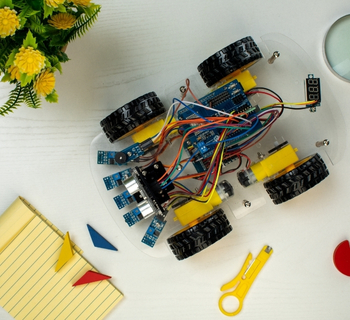
From Spark to Circuit. This is where the magic of technology is demystified. This course is your hands-on guide to the fundamental laws and components that power the entire modern world. You won't just read about Ohm's Law; you'll use it. We take you from zero knowledge to confidently building and troubleshooting your own working circuits on a breadboard.
- Build the Bedrock of Your Technical Skills.You will gain practical, hands-on mastery of:The Fundamentals: Understand the "big three": Voltage ($V$), Current ($I$), and Resistance ($R$) and how they relate (Ohm's Law).
- Essential Components: Learn the why and how of resistors, capacitors, diodes, LEDs, and inductors.
- The Transistor: Master the transistor (BJT & MOSFET), the single most important invention of the 20th century, and learn to use it as a switch or an amplifier.
- Essential Tools: Learn to use a multimeter to measure and test, a breadboard to prototype, and a soldering iron to build permanent projects.
- Core Circuits: Build and understand power supplies, basic amplifiers (using op-amps), and logic gates (the building blocks of computers).
- Learn by Building, Testing, and Fixing. Our program is designed to get your hands on the hardware immediately:
- Physical Kit Included: You'll get a complete electronics starter kit with all the components, wires, breadboards, and tools you need.
- Interactive Simulation: Test your circuit in a virtual simulator (like Tinkercad) to see what should happen before you build it.
- Step-by-Step Project Labs: Follow along as our instructors guide you in building real-world projects like a dimmable LED circuit, a simple audio amplifier, or a 555-timer-based alarm.
- Troubleshooting Sessions: We dedicate time to the most important skill: what to do when your circuit doesn't work.
- A-E-C: A Cursory Education in electronics (Absolutely None!) This course is for absolute beginners. It's perfect for:
- Hobbyists who want to build their own gadgets.
- Students in robotics, computer science, or mechatronics who need a strong hardware foundation.
- Anyone who wants to finally understand how the technology around them actually works. You just need a curious mind and a willingness to tinker!
You Will Be an Electronics "Builder." Upon completion, you will receive a Foundation in Electronics Certificate. You will be able to read a basic circuit schematic, design and build your own simple-to-intermediate circuits, and confidently solder and troubleshoot. This course is the essential prerequisite for moving into robotics, IoT, or our Advanced Electronics program.
Advanced Electronics & System Design
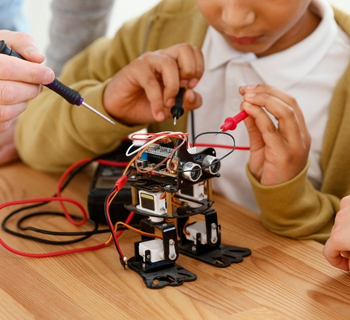
Go from Builder to Architect. This is where you go pro. In the foundation course, you learned to build circuits. In this course, you will learn to engineer and design complete, manufacturable electronic systems. We move past the breadboard and into the world of microcontrollers, high-speed signals, and professional Printed Circuit Board (PCB) design. This is the skill set that separates the hobbyist from the hardware engineer.
- Become an Electronics & Embedded Systems Specialist. You will gain elite-level skills in the most in-demand areas:
- Microcontroller Systems (Bare-Metal): Go deeper than Arduino. Learn to program ARM, RISC-V, or PIC microcontrollers in C/C++. You'll control registers, set up peripherals (like SPI, I2C, UART), and manage real-time tasks.
- Professional PCB Design: Master an industry-standard tool (like Altium, KiCad, or Eagle). You'll learn multi-layer board design, create custom component footprints, and manage signal integrity.
- Specialization Tracks: Choose a focus area:
- Power Electronics: Design efficient switch-mode power supplies (SMPS), motor controllers, and battery management systems (BMS).
- RF & Wireless: Design circuits for Wi-Fi, Bluetooth, and LoRa, including antenna matching and filter design.
- Digital Systems: Learn FPGA/CPLD programming using a hardware description language (VHDL or Verilog).
- Think Like an Engineer, Deliver a Product. This program is structured to mimic a professional engineering environment:
- Industry-Standard Software: You will spend all your time in professional-grade design and simulation software.
- Capstone Design Project: You will take an idea from concept to completion. You'll design the schematic, lay out a multi-layer PCB, order it from a manufacturer, solder the components (including SMT), and write the firmware.
- Datasheet Deep Dives: Learn to read and interpret complex datasheets and application notes—the real skill of an engineer.
- Design & Code Reviews: Present your designs and code to instructors and peers to learn how to defend your engineering decisions.
- This Is an Expert-Level Program. This course is for those with a strong and proven foundation. We require:
- Completion of our Foundation/Intermediate Course (or an equivalent portfolio).
- You must be able to read complex schematics and be proficient with a multimeter and oscilloscope.
- You must understand transistor-level and op-amp circuits.
- Basic programming experience (in C or Python) is essential for the microcontroller sections.
- Qualify for High-Demand Hardware Roles. Completing this course and its capstone project positions you for the most senior and specialized roles in tech. You will receive an Advanced Electronics Design Certificate and be a prime candidate for:
- Electronics Engineer
- Hardware Engineer
- Embedded Systems Engineer
- Firmware Developer
- PCB Designer/Engineer
- RF Engineer
- Power Electronics Engineer